 how-to
How Do You Choose Organic Perfume for Sensitive Skin?
Last Updated: November 8, 2026
Quick Summary
Choose an organic perfume for sensitive skin by reading the full ingredient list, not the highlights panel, and asking the brand to disclose its fragrance allergens and scent blend. Patch test one product on your inner forearm for 48 to 72 hours before wider use, and favor lighter concentrations and oil-based formulas over alcohol sprays.
- Fragrance is one of the most common causes of allergic contact dermatitis, and hypoallergenic is a marketing term, not a regulated standard.
- Essential oils are concentrated plant extracts, and several are recognized fragrance allergens, so botanical does not mean safer.
- Unscented products often contain masking fragrances, so the label can read unscented while still containing a fragrance blend.
- Apply one drop of perfume oil or one short spray to a marked inner forearm site and check at 24, 48, and 72 hours.
- Spray onto clothing or hair instead of skin, apply to pulse points only, and choose perfume oil over alcohol spray for reactive skin.
Table of Contents
- Start With Your Skin: Why Fragrance Sensitivity Happens
- Perfume for Sensitive Skin: What a Dermatologist Would Tell You
- Read the Label: Ingredients to Avoid and Allergen Disclosures
- Natural, Organic, Clean, and Hypoallergenic: What the Claims Actually Mean
- 100% Natural Perfume: Promise vs. Reality for Sensitive Skin
- How to Patch Test a New Perfume: A Step-by-Step Protocol
- Application Methods That Reduce Exposure and Irritation
- Organic Perfume Brands: How to Evaluate Quality and Transparency
- Frequently Asked Questions
Start With Your Skin: Why Fragrance Sensitivity Happens
Fragrance sensitivity is an adverse reaction to one or more compounds in a scent, and it can show up as redness, itching, sneezing, or headaches.
Many people have reacted to "natural" products before. That experience teaches an important lesson: plant-derived does not mean reaction-free.
Fragrance mixes can contain dozens of compounds. Some are volatile and reach the skin fast. Others linger.
A few patterns explain most reactions:
- Irritation builds up over repeat use, often from alcohol-heavy sprays
- Allergy appears after prior exposure and can worsen each time
- Scent sensitivity triggers headaches or nausea without any visible rash
Watch out: assuming a reaction will stay mild.
Perfume for Sensitive Skin: What a Dermatologist Would Tell You
The practical advice follows from it. Choose fewer ingredients, apply less, and test before you commit. Patch testing matters more than any claim on the box.
According to the American Academy of Dermatology's guidance on patch testing, testing a small area first is the standard way to spot a reaction before it spreads.
Three habits dermatologists tend to recommend:
- Keep a written log of products and reactions
- Introduce one new scent at a time
- Favor lighter concentrations over intense parfums
If a reaction involves swelling, trouble breathing, or spreads beyond the contact area, that is a medical issue. See a doctor rather than experimenting further.
Read the Label: Ingredients to Avoid and Allergen Disclosures
Label reading is where most buying decisions should start, and it is also where most shoppers get stuck. The problem is not that ingredient lists are hard to find, it is that they are often incomplete by design. Fragrance blends can be listed simply as "fragrance" or "parfum" without disclosing the individual compounds inside, which means the ingredient most likely to trigger a reaction may be the one you cannot see.
Start With the Full List, Not the Highlights Panel
A highlights panel ("free of parabens," "no phthalates") tells you what a brand chose to advertise. The full ingredient list, usually on the back or side of the box, tells you what is actually in the product. If a brand publishes only highlights online, treat that as a disclosure gap rather than a clean bill of health.
Parabens, Phthalates, and Artificial Dyes
- Parabens are preservatives used to extend shelf life. They are not fragrance allergens in the classic sense, but some shoppers with reactive skin choose to avoid them.
- Phthalates are used to help scent last and to soften texture. They are frequently folded into a generic "fragrance" listing rather than named, which is exactly why full disclosure matters.
- Artificial dyes add color and serve no functional purpose in a scent. They are easy to avoid and easy to spot, look for FD&C or D&C color names.
Fragrance Allergens and Essential Oils
A common mistake is assuming botanical ingredients are safer. They are not automatically. Essential oils are concentrated plant extracts, and several are recognized fragrance allergens. A perfume built entirely from essential oils can carry a heavier allergen load than a carefully formulated synthetic blend.
This is why allergen disclosure matters more than the natural-versus-synthetic debate. Disclosure rules for individual fragrance allergens vary by market, so the burden often falls on the shopper to ask.
How to Handle a Generic "Fragrance" Listing
When a blend is listed generically, you have three practical options:
- Ask the brand directly. Request the allergen statement or the full fragrance composition. A brand that formulates for sensitive skin should be able to answer questions about its ingredients.
- Look for a published allergen declaration. Some brands list the recognized fragrance allergens separately from the "fragrance" line. That is a meaningful transparency signal.
- Treat silence as information. If a brand cannot or will not tell you what is in its scent blend, that is a data point about how it treats sensitive-skin customers.
Watch out: assuming "unscented" means fragrance-free. Unscented products often contain masking fragrances to neutralize the smell of other ingredients, so the label can read "unscented" while still containing a fragrance blend (the FDA).
Questions Worth Asking Before You Buy
- Is the full ingredient list published, or only highlights?
- Are known fragrance allergens declared individually?
- Is the scent blend disclosed, or listed only as "fragrance"?
A brand that answers these clearly is usually the one worth trusting with reactive skin.
Natural, Organic, Clean, and Hypoallergenic: What the Claims Actually Mean
These four words are not interchangeable, and confusing them is the most common mistake we see.
- Natural means ingredients come from nature. It says nothing about safety.
- Organic refers to how ingredients are grown and processed.
- Clean is a marketing term with no legal definition.
- Hypoallergenic suggests lower allergy risk but carries no standard.
For a full breakdown of what organic means in practice, see how we define organic ingredients.
A genuinely organic perfume should name its sources and show certification. If a brand cannot tell you where its ingredients come from, the claim is worth questioning.
100% Natural Perfume: Promise vs. Reality for Sensitive Skin
A 100% natural perfume avoids synthetic fragrance, but it is not automatically gentler. Botanical extracts carry their own allergens, and concentration matters as much as origin.
A natural scent with a short ingredient list may suit reactive skin better than a complex synthetic blend, but individual results vary.
What most guides miss is the carrier. Alcohol-based sprays dry the skin and drive ingredients in fast.
How to Patch Test a New Perfume: A Step-by-Step Protocol
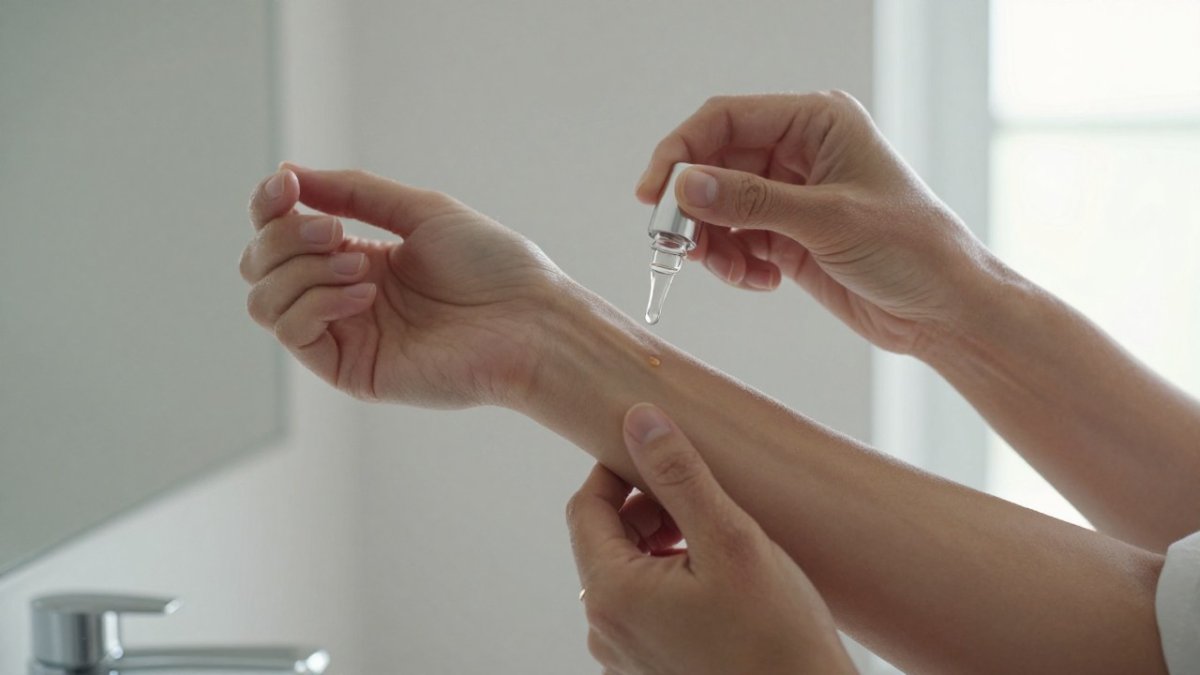
Patch testing is the closest thing to a home trial for a fragrance, but most guides reduce it to "put some on your arm and wait." That version fails for two reasons: it does not control the dose, and it does not account for the delayed reactions that fragrance allergens are known for. A proper protocol takes about 48 hours of elapsed time and roughly 10 minutes of hands-on work.
The woman is American.
Before You Start
- Pick one product. Testing two scents at once makes a reaction impossible to attribute.
- Choose a quiet test site. The inner forearm is standard because it is thin-skinned, easy to keep dry, and easy to photograph. Avoid the wrist, which rubs against sleeves and watches, and avoid the neck and face entirely for a first test.
- Skip broken, sunburned, or freshly shaved skin. A compromised barrier will react to almost anything and tell you nothing useful.
- Do not apply other scented products to the test area, lotion, deodorant, or hand cream, for the duration of the test.
The Protocol
- Mark the site. Draw a small circle on the inner forearm with a ballpoint pen and note which arm and where. This matters more than it sounds: reactions can be subtle, and a marked site is easier to compare at 24 and 48 hours.
- Apply a controlled dose. One drop of perfume oil, or one short spray held several inches away, is enough. More product does not produce a more accurate result, it produces a bigger reaction that may not reflect normal wear.
- Let it dry fully and leave it uncovered. Do not rub it in, do not cover it with a bandage, and do not wash the area for at least 24 hours. Water and friction both distort the result.
- Check at 24 hours. Look for redness, itching, swelling, or a raised bump confined to the marked circle. Photograph the site in consistent light so you can compare later.
- Check again at 48 hours, and once more at 72 if you can. Fragrance allergy is classically a delayed hypersensitivity reaction, which means a first reading at 24 hours can look clean while a reaction develops on day two or three. Most practitioners find the 48-to-72-hour window is where fragrance reactions actually show up.
- Record the result in writing. Note the product name, batch or lot number if printed, the test site, the dose, and any symptoms with timestamps. This log becomes your reference when you try the next scent.
Reading the Result
- No reaction at 72 hours: the scent is a reasonable candidate to try on a wider area, starting with a single pulse point.
- Mild redness or itch that fades: treat it as a sensitivity signal and stop. Do not "push through" to build tolerance, with fragrance, repeated exposure tends to worsen sensitization rather than resolve it.
- Swelling, blistering, spreading beyond the test site, or any breathing difficulty: stop and seek medical advice. Those are not patch-test findings; they are reasons to see a clinician.
Watch out: testing on the wrist because it is convenient. The wrist is one of the most friction-exposed and wash-exposed spots on the body, so a reaction there is easy to miss and easy to misattribute.
What Patch Testing Cannot Tell You
A patch test measures one product on one small area over a few days. It will not catch a reaction that only appears with daily use over weeks, and it will not identify which specific compound in a blend is responsible.
A proper patch test takes about 48 hours of elapsed time and roughly 10 minutes of hands-on work, following these steps.
| Step | What to do | Timing |
|---|---|---|
| Mark the site | Draw a small circle on the inner forearm with a ballpoint pen | Before applying |
| Apply a controlled dose | One drop of perfume oil or one short spray held several inches away | Before applying |
| Let it dry | Leave uncovered, do not rub in or wash the area | At least 24 hours |
| First check | Look for redness, itching, swelling, or a raised bump | 24 hours |
| Second check | Photograph and compare against the marked circle | 48 hours |
| Final check | Fragrance reactions often show up in this window | 72 hours if possible |
| Record the result | Note product name, batch number, site, dose, and symptoms | After each check |
Application Methods That Reduce Exposure and Irritation
Where and how you apply matters as much as what you apply. Less product and fewer contact points mean lower exposure.
Try these adjustments:
- Spray onto clothing or hair instead of skin when possible
- Apply to pulse points only, not broad areas
- Choose perfume oil over alcohol spray for dry or reactive skin
- Reapply once, not repeatedly through the day
Carrier oils make a real difference here. Jojoba oil and squalane are close to the skin's own oils and feel gentle. If you want a scent you can tailor, our custom woody blend lets you combine a limited number of natural fragrances. The custom rose blend keeps the mix small and controlled.
Organic Perfume Brands: How to Evaluate Quality and Transparency
Judging an organic perfume brand comes down to disclosure. A brand that answers ingredient questions clearly is usually the one worth trusting.
Use this checklist before you buy:
- Full ingredient list published, not just highlights
- Allergen information available on request
- Certifications named and verifiable
- Sourcing described for key ingredients
Our own customers ask how they can verify organic claims. You can contact us with ingredient or sourcing questions before ordering, and browse our perfume collection to review what goes into each scent.
Pricing depends on quantity, dates, and delivery. Visit the Primrose Essence Atelier website for current prices or a quote.
Fragrance sensitivity does not mean giving up scent. It means choosing carefully, testing first, and buying from makers who tell you exactly what is inside.
Frequently Asked Questions
What is the best perfume for sensitive skin?
There is no single best perfume for sensitive skin because reactions vary by person. Look for fragrances with short ingredient lists, no parabens or phthalates, and disclosed allergens. Perfume oils with carrier oils like jojoba or squalane tend to be gentler than alcohol-based sprays. Always patch test on a small area for 24 to 48 hours before regular use. If you have a diagnosed condition like eczema, ask a dermatologist for guidance on specific ingredients to avoid.
Are natural perfumes always safer for sensitive skin?
No. Natural ingredients, including essential oils, can trigger allergic reactions just as synthetic ingredients can. For example, limonene and linalool are common fragrance allergens found in natural citrus and floral oils. The key is to read the full ingredient list, check for allergen disclosures, and patch test. A perfume labeled 100% natural perfume is not automatically hypoallergenic. Focus on your own sensitivity history and test any new product carefully.
How can I tell whether an organic perfume may irritate my skin?
Start by reviewing the ingredient list for known allergens such as essential oils, parabens, phthalates, and artificial dyes. Look for brands that disclose full ingredients and allergen information. Before full application, perform a patch test: apply a small amount to your inner forearm, cover with a bandage, and wait 24 to 48 hours. If you see redness, itching, or swelling, discontinue use. For recurring reactions, a dermatologist can help identify specific triggers through testing.
What ingredients should people with fragrance sensitivities look for or avoid?
Avoid parabens, phthalates, artificial dyes, and synthetic musks if you have known sensitivities. Also watch for essential oils like citrus, lavender, and peppermint, which can cause reactions. Choose fragrance-free or hypoallergenic formulas when possible, and look for short ingredient lists with carrier oils like jojoba or squalane. Always check allergen disclosures, as labeling requirements vary. When in doubt, patch test and consult a dermatologist for personalized advice.